How do I know if AI is actually skipping my company when people search?
The simplest test: Open ChatGPT or Perplexity in an incognito browser. Search for exactly what you do using the language your ideal client would use. For example, "commercial insurance broker for manufacturing companies in Ohio" or "capital raising advisor for renewable energy projects."
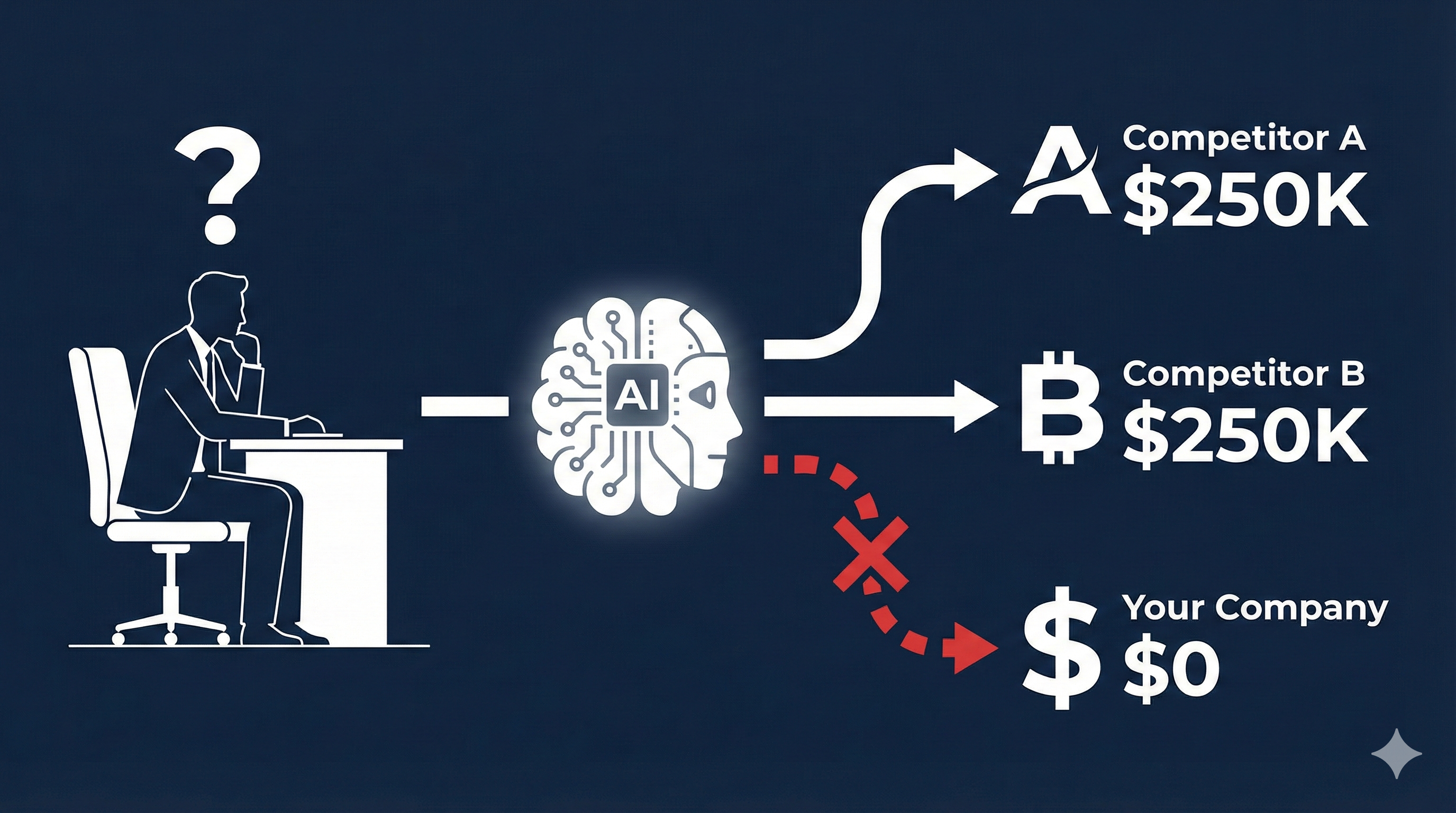
Look at the recommendations. If you are not in the top three results, you are invisible. If your competitors are listed and you are not, AI is recommending them instead of you right now.
Most companies have no idea this is happening. They assume their website traffic tells the whole story. It does not. AI search does not send traffic to your site. It recommends you directly or it does not. There is no middle ground.
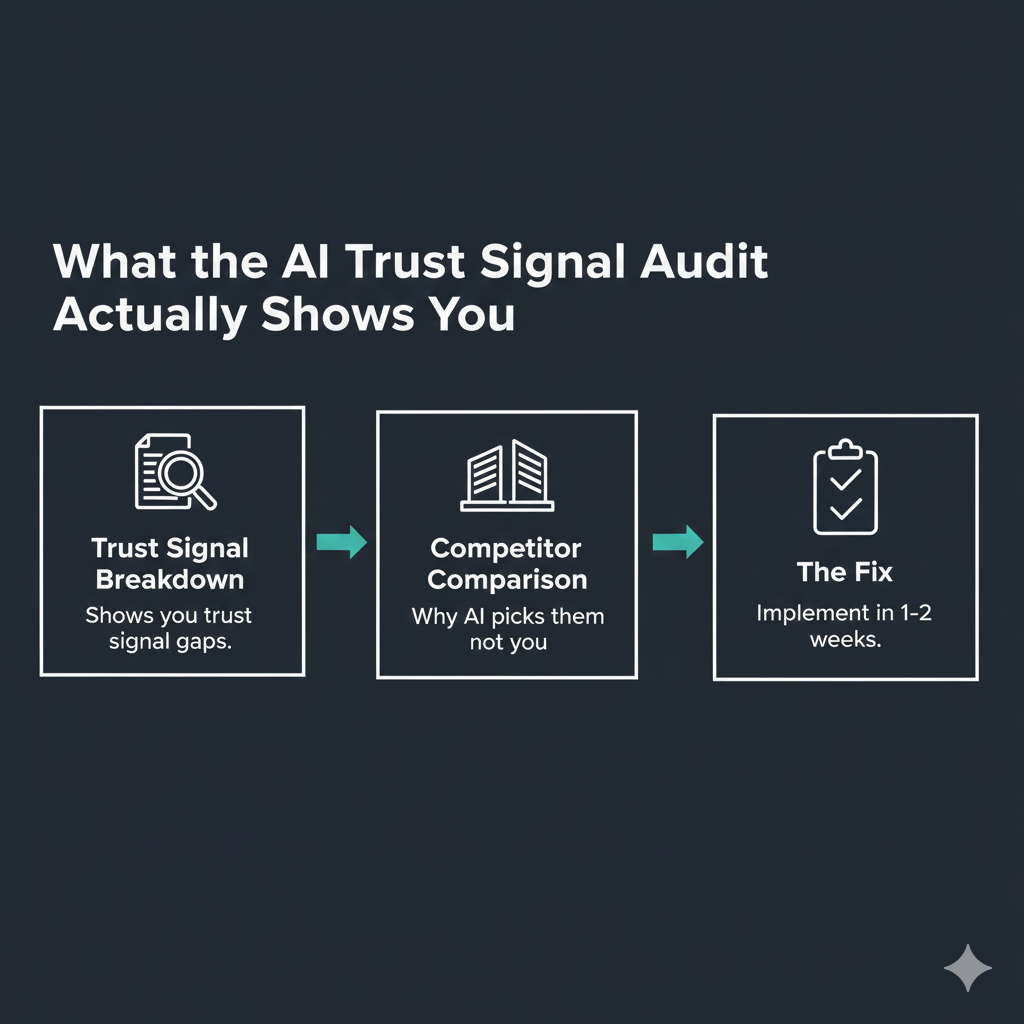
The AI Trust Signal Audit shows you exactly where you appear across eight different AI systems, where your competitors appear, and why AI is choosing them over you.
What exactly are trust signals and why do they matter more than my website content?
Trust signals are the breadcrumbs of credibility you leave across the internet. Your website is one signal. LinkedIn is another. Industry publications, case studies, speaking engagements, client testimonials, news mentions, awards, certifications, conference presentations, published research, podcast appearances, and verified business listings are all trust signals.
AI does not just read your website and decide if you are credible. It cross references everything it can find about you to see if your story is consistent.
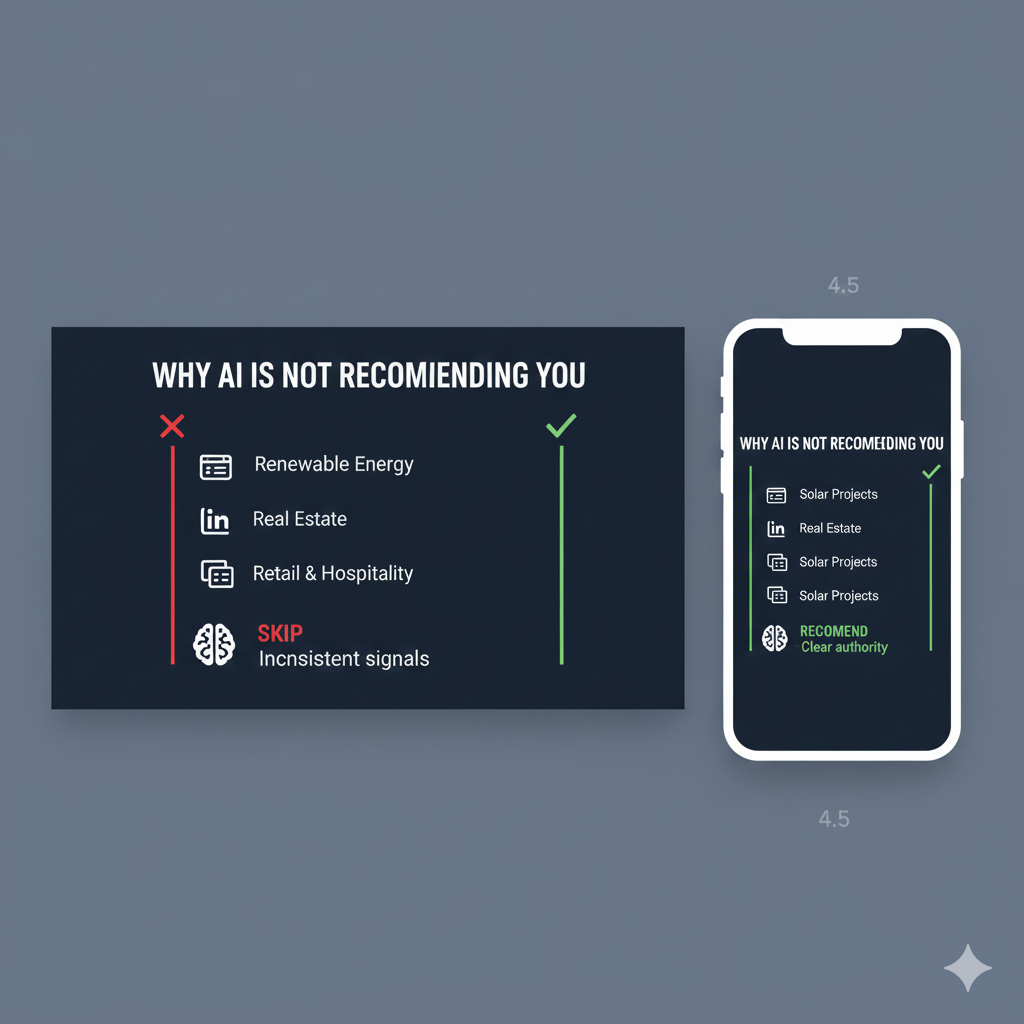
If your website says you specialize in renewable energy but your LinkedIn profile talks about real estate and your case studies show hospitality clients, AI sees conflicting information. It does not know which version of you is real, so it skips you and recommends someone with a clear, consistent story.
Your competitors are not necessarily better at what they do. They are just better at presenting a unified message across every platform AI checks.
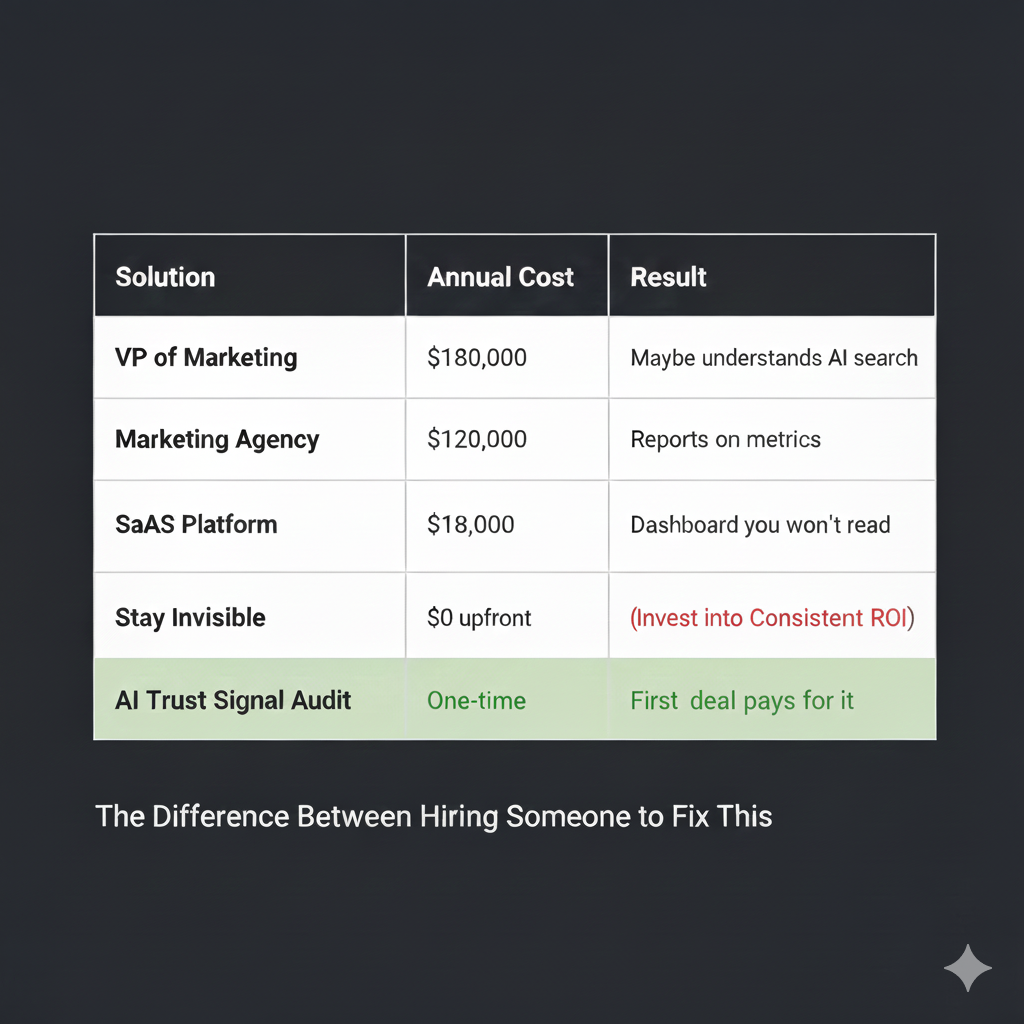
Why can't I just hire my marketing team to fix this?
Your marketing team is excellent at what they were trained to do: drive website traffic, manage social media, create content, run ad campaigns, track engagement metrics.
AI search optimization is fundamentally different. It is not about traffic. It is not about SEO keywords. It is not about posting frequency.
It is about trust signal alignment across platforms most marketing teams never think about. It requires understanding how AI systems evaluate credibility, what sources they prioritize, how they weigh conflicting information, and what specific patterns trigger recommendation versus being skipped.
Most marketing professionals have never worked with AI search because it is newer than their training. They are still optimizing for Google page one rankings while decision makers are bypassing Google entirely and asking ChatGPT to recommend three companies.
The audit gives your team the exact roadmap. They can implement it. But someone needs to diagnose the problem first, and that diagnosis requires specialized knowledge of how AI recommendation engines work.
How long does it take to see results after fixing my trust signals?
AI systems re-crawl and re-index information constantly. Some changes show up within days. Others take two to four weeks.
The timeline depends on what you are fixing. Updating your website and LinkedIn can improve your positioning within a week. Getting your information updated in industry directories or citation sources might take three to four weeks as AI systems re-scan those sources.
The important thing to understand is that this is not a six month SEO project. You make the changes, and AI picks them up on its next crawl cycle.
Most companies see their first AI-driven inquiry within 30 days of implementing the fixes. Some see results faster if they are in high-search industries.
The audit tells you exactly which changes will have immediate impact and which ones are longer term credibility builders.
What if my competitors have been in business longer or have bigger brands?
AI does not care how long you have been in business. It cares about trust signal clarity and consistency.
A 50 year old company with fragmented messaging across the web will lose to a 5 year old company with tight, consistent positioning. AI is looking for signals that help it make a confident recommendation. Age and size are only factors if they correlate with clearer trust signals.
In fact, older companies often have worse trust signal problems because they have accumulated contradictory information over decades. Old case studies from markets they no longer serve. Outdated LinkedIn profiles from previous executives. Press mentions about services they discontinued. Legacy content that conflicts with their current positioning.
Newer companies with intentional, consistent messaging across every platform often outperform established players in AI search because they built their online presence with clarity from day one.
The audit shows you how to compete on trust signals regardless of how long you have been in business.
Do I need to be on every social media platform for AI to recommend me?
No. AI does not care how many platforms you are on. It cares about the consistency of your message across whatever platforms you do use.
Being on three platforms with unified, clear positioning is infinitely better than being on ten platforms with scattered, contradictory messaging.
The key platforms AI checks most frequently for B2B services are your website, LinkedIn, industry specific directories, news mentions, case study publications, and verified business listings. If those six sources tell the same story about who you serve and what problems you solve, you are in good shape.
Social media volume does not impress AI. Message alignment does.
The audit identifies which platforms AI is checking for your industry and shows you where your messaging breaks down across those specific sources.
What happens if I fix my trust signals but my competitors do the same thing?
You are competing on credibility, not traffic volume. This is not a zero sum game where only one company can be recommended.
AI will recommend multiple companies if they all have strong, aligned trust signals. The difference is whether you are in that recommended group or excluded from it entirely.
Right now, if your trust signals are fragmented, you are not competing with your competitors. You are not even in the conversation. You are invisible.
Fixing your trust signals puts you in the game. After that, AI will recommend you alongside competitors, and the decision comes down to other factors like geographic location, specific expertise areas, case study relevance, or pricing.
But none of that matters if you are not being recommended in the first place.
The goal is not to be the only company AI recommends. The goal is to be one of the companies AI considers credible enough to recommend at all.
Can I just pay for ads to show up in AI search results?
Not yet, and maybe not ever in the way you are thinking.
Some AI systems are experimenting with sponsored placements, but the organic recommendation algorithm is still the primary way companies get visibility.
More importantly, decision makers using AI search are specifically trying to avoid ads. They are asking AI to recommend credible companies based on merit, not based on who paid for placement.
If AI becomes pay to play, users will move to different AI systems that provide unbiased recommendations. The entire value proposition of AI search is getting trusted recommendations, not seeing who bought the top spot.
Your best strategy is to position yourself as organically recommendable through trust signal alignment. That foundation will serve you regardless of how AI advertising evolves.
How is this different from SEO or content marketing?
SEO is about getting your website to rank on page one of Google search results. Content marketing is about creating valuable content that attracts visitors to your website.
AI search does not work that way.
AI does not show a list of websites ranked by relevance. It analyzes your credibility across multiple sources and either recommends you directly or it does not. There is no page two. There is no clicking through to your website to learn more. AI makes the recommendation based on what it already knows about you.
SEO and content marketing are about visibility. AI search optimization is about recommendability.
You can have perfect SEO and thousands of website visitors per month but still be invisible in AI search if your trust signals are inconsistent. Because AI is not reading your website in isolation. It is cross referencing everything it can find about you to decide if you are trustworthy enough to recommend.
The skills required are completely different. The audit addresses the AI search problem specifically, not the SEO problem.
What if I operate in a very niche market with low search volume?
Niche markets are often better positioned for AI search success than broad markets.
AI recommendation works exceptionally well in specialized industries because AI can quickly identify the small number of credible experts in that space. If you are one of five companies in the country that does lithium extraction consulting, AI will recommend you if your trust signals are aligned.
In broad markets like general business consulting, AI has to sift through thousands of options. In niche markets like industrial mineral processing or renewable energy structured finance, AI has fewer options to evaluate, so the companies with clear trust signals rise to the top faster.
Low search volume is not a problem. What matters is whether the searches that do happen result in you being recommended or skipped.
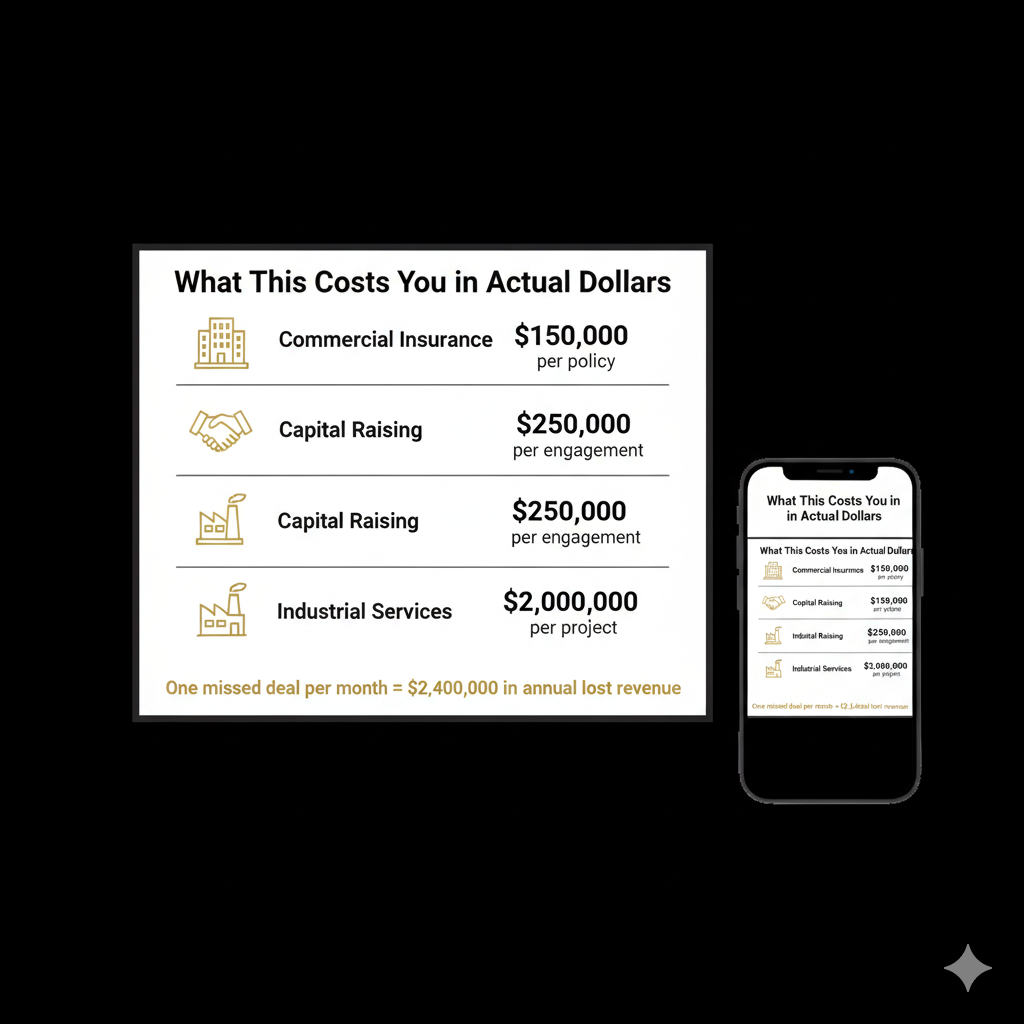
If ten qualified prospects per month search for what you do, and AI recommends your competitor instead of you in all ten searches, you are losing ten opportunities. In a niche market where deals are $500K to $2M, that is catastrophic.
The audit shows you exactly how AI is evaluating your niche and what you need to do to dominate it.